Marketing as an Investment Model

When you pick a niche topic and start digging, it usually becomes a much bigger system much faster than expected.
Last year, Barbara and I decided to go all in on marketing measurement. Not that we have not done it before. Both of us have years of experience in that. But it was “just” a part of the work and not a clear research topic.
When we started, we wanted to find out how to make marketing teams more confident with data, and how to break the unproductive cycle of “we can’t track everything we need” and “how are we supposed to make decisions with this data”.
There are different ways to get there. Mine is to understand a topic from as many angles as possible. This post is about an angle I have been tinkering with for the last four weeks.
What if we treat marketing as a classic investment model?
When I focused on product measurement in the last few years, I used to say that marketing measurement is easy compared to product measurement. You have campaigns that land on your website and a conversion event to measure against. Two events, one conversion rate, and a few money-based metrics derived from it like ROAS or CLV. But I always added a caveat: “as long as we exclude attribution”.
In a lot of marketing setups, attribution has become a dark spot that, in the worst case, dictates too many conversations about marketing performance. Teams churn through agencies to get percent by percent “more data” for better attribution. Or they launch initiatives that are not the usual easy-to-track campaigns, and then have no way to justify them internally, because the reporting shows no impact.
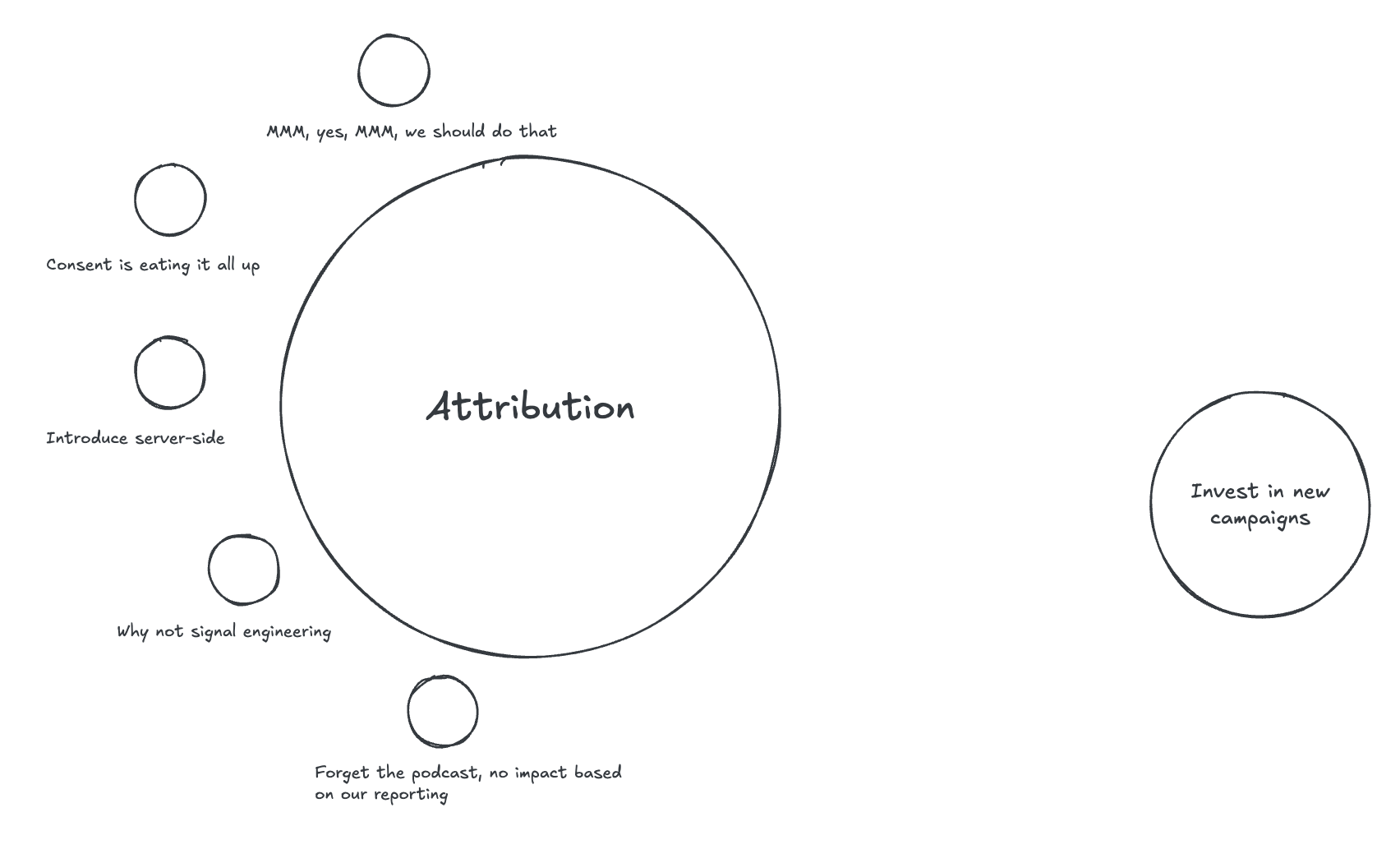
I have always worked with marketing teams from a data or engineering perspective, and the best moments were the collaborations with creative teams who found new combinations of message, format, and channel to reach more of the right ICP. When I see marketing teams held back from that, it hurts.
That is what triggered this model and this post. In my view, attribution gets the wrong role in most setups. That is not attribution’s fault. It is a strategic decision companies make without noticing.
To make the point, I will walk you through a marketing model borrowed from basic financial investment. Really basic. The goal is to show what role attribution can play so that it supports marketing teams instead of getting in their way.
Start with the simplest model possible
Any investment follows the same form: you put something in, and you need to get more back than you put in. What you invest is usually money. It can also be time, but the return is usually monetary, so we monetise time as well (hourly rates).
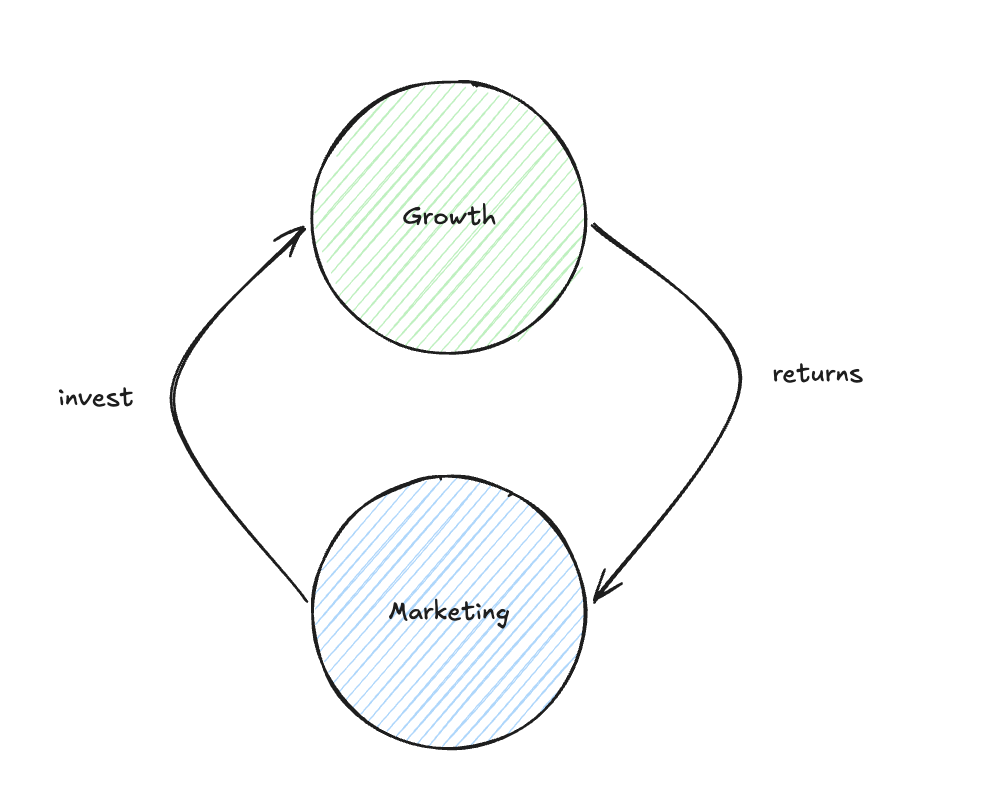
So in simple terms:
Returned money − Invested money > 0
or Returned money / Invested money > 1
The same is true for marketing. In the simplest form of marketing measurement:
Contribution margin − Marketing spend (ad spend, salaries, agencies) > 0
Contribution margin / Marketing spend (ad spend, salaries, agencies) > 1
Or, if you can run a longer horizon analysis:
CLV / CAC > 1
This tells you whether the business can sustain itself economically at the current level of marketing investment. It does not tell you how much of the outcome marketing actually caused.
But it does give you portfolio-level feedback. Defensively: as long as your contribution margin stays above your marketing spend, marketing is growing the business. And once you have a CLV model you trust, you have more room to invest.
This straightforward calculation is missing more often than you would expect. For a smaller business, or one that is just starting out, it is basically the only way to measure marketing performance with any confidence.
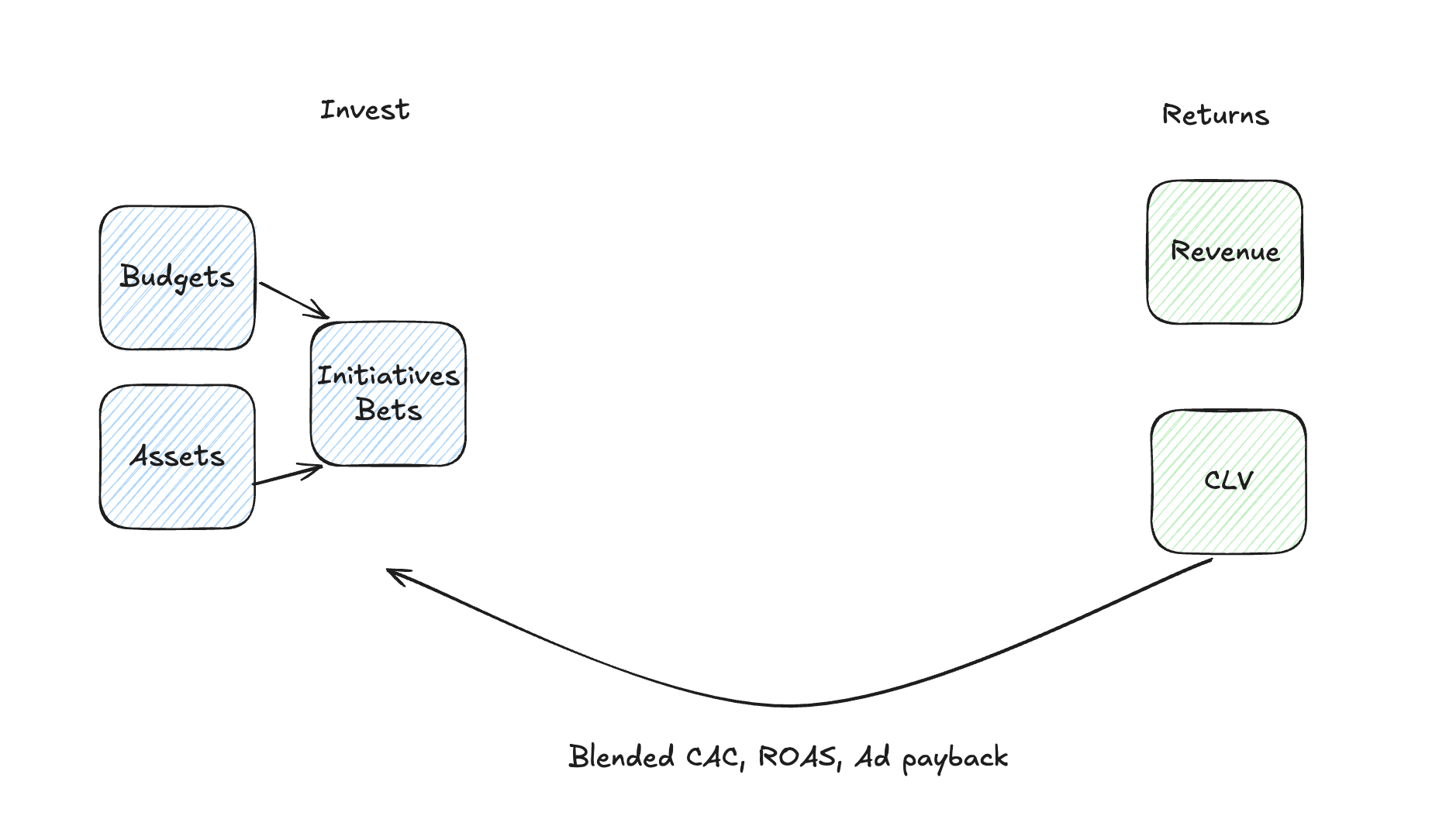
Three concepts come out of it:
Investment, or inputs. This is where marketing works.
Returns. The output of the marketing work, which you cannot influence directly.
Portfolio. For now, just the total of all marketing initiatives.
No attribution is required for any of this. So when do we need attribution?
When we want to understand what is inside the portfolio.
Marketing initiatives as investment assets
Marketing works in initiatives. A new webinar is an initiative. A new ad type test starts as one too. Initiatives have a start and an end. When they work, they become always-on: proven value, now needing ongoing monitoring and refinement.
Marketing portfolio = Initiatives + Always-on
In financial terms, initiatives and always-on become our investment assets, and we want to understand how each of them performs. Not only the portfolio value over the last three months, but how each asset has moved inside it.
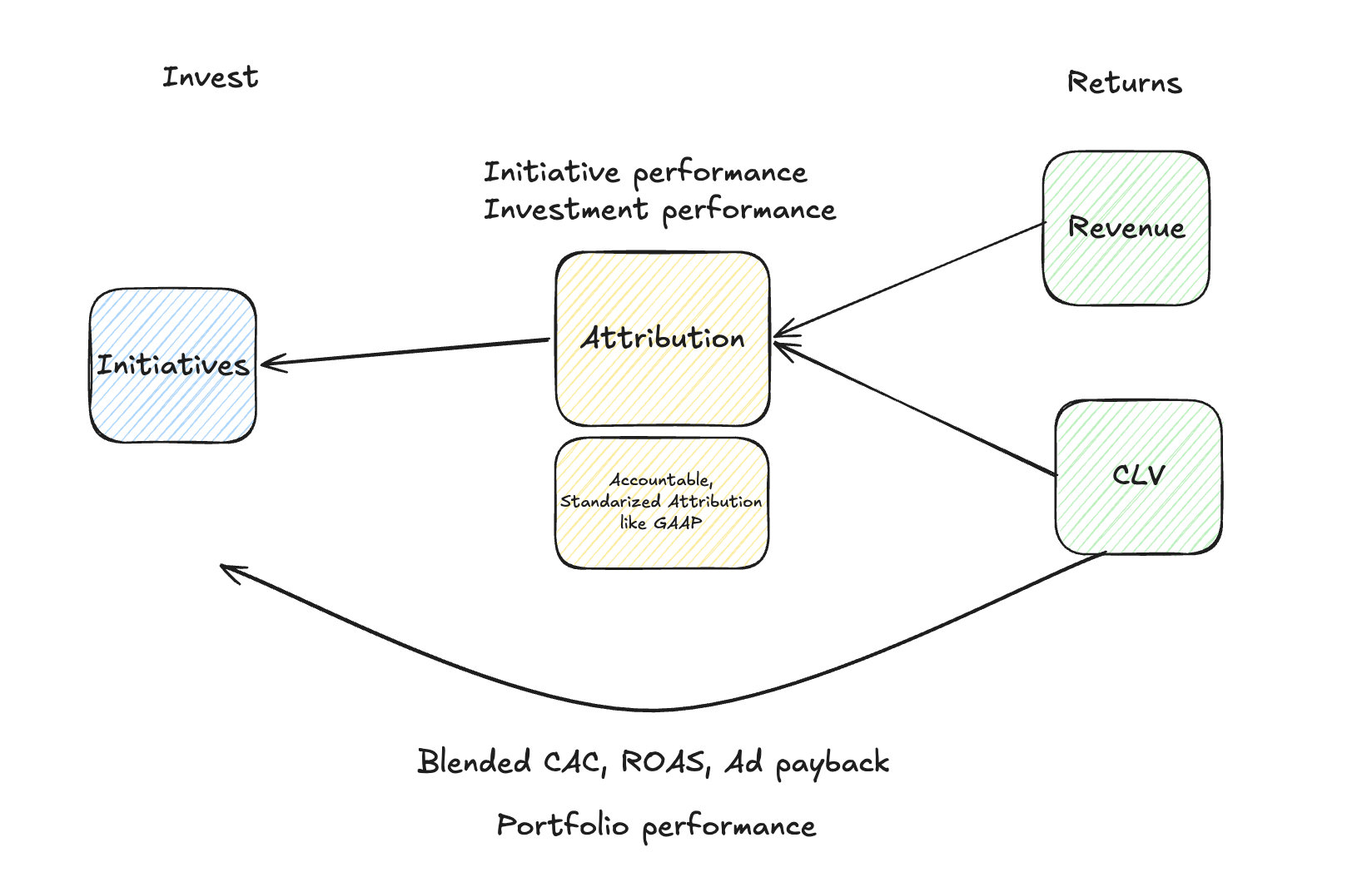
And now we need attribution. Only when we can attribute returns to an initiative can we decide whether the returns justify keeping it.
Financial investment sits in a similar place. The value of a financial asset, like shares in a company, is unknown. You have a nominal value, you know what you paid, but what you actually get back you only know the day you sell.
Markets did not solve the problem of knowing an asset’s true value. They solved the problem of observability. A stock exchange gives you a price at any moment, because there is always someone on the other side willing to trade.
Marketing initiatives have no equivalent observable price. They are not independently traded, and their contribution cannot be separated from the rest of the business through a transaction. There is nobody on the other side of the trade, and we will never have enough attributable data points to fake one.
This is exactly what attribution tools promise you anyway. That they found a way to price your marketing initiative. And they do produce a number. It is not nothing, it is usually a correlation, sometimes a useful one. But it is not a price. Treating it like one is how marketing teams end up defending a figure that nobody in the company can explain.
So let’s drop the stock exchange. It was the wrong part of finance to look at.
The interesting part happens long before a company ever reaches an exchange. It is accounting.
Because accounting deals with exactly our problem. Take depreciation. What is a three-year-old delivery van worth? Nobody knows. There is no van market ticking every second. So finance did not wait for a perfect answer. They agreed on a rule — straight line over five years — wrote it down, applied it consistently, and made it reviewable. Nobody in the company believes the van is worth exactly that number. Everybody knows how the number was produced. And that turns out to be enough to run a business on.
Revenue recognition works the same way. When do you count a twelve-month contract as revenue? There is no true answer. There is a documented policy, applied the same way every quarter, and someone who checks that you followed it.
That is the standard we should borrow. Not a better estimate. A shared convention.
So my hypothesis is this: stop looking for a model that estimates the true value of a marketing initiative. That model does not exist. Instead, treat your attribution model as your company’s revenue recognition policy for marketing. Standardised, written down, applied the same way every month, and open to review by anyone who has to make a decision based on it.
Auditable attribution
No attribution model can explain your customer journeys. Never. We can’t even do it for ourselves. Take one of your bigger purchases in the last three months. Do you know which touchpoint mattered most? Customer journeys are complex. Marketing setups are complex.
In a world of imperfect models, I prefer the one I can explain to anyone in the organisation. Take a customer who has accumulated a significant CLV. What if you had a detailed trace showing which touchpoints first brought them in, which one we picked as the attribution winner and why, and then the same for every following purchase? And what if we used that trace to refine the model?
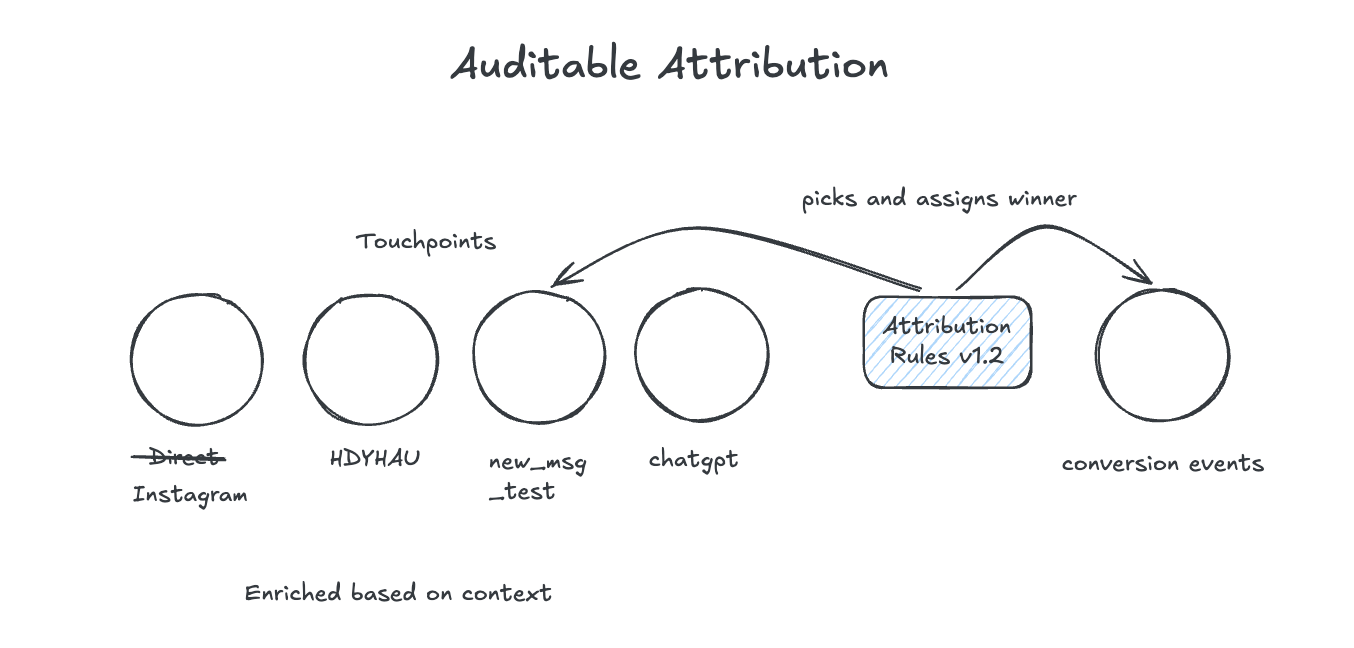
That is what I call an auditable attribution model. One of the few good reasons to cling to last touch is that it can be audited — but it is far too limited to serve as a general model.
The models we implement today are rule engines, configured and changed by the marketing team, because they are the only team with the domain knowledge to make educated assumptions. The rules are easy to make visible to the whole company. They are implemented in the data model and can be versioned. That lets other teams audit them, and it turns model changes into constructive meetings rather than arguments about whose number is right.
One rule about the rules: they are set before the period they apply to, not after the numbers come in. That is the difference between a policy and a rationalisation.
What does a rule set look like? Something like this:
- If the user redeems a podcast discount, has a touchpoint with the podcast landing page URL, or mentions the podcast in the “How did you hear about us” survey, the podcast wins the conversion (it is our main initiative, and our hypothesis is that these customers stay with us longer — which we monitor via CLV over time)
- If not, and there are paid touchpoints in the last 60 days, we take those; if there are several, we take the first
- If not, we use the survey answer
The design loop is the share of direct, non-attributable conversions. The goal is simple: get it below 5% through reasonable re-qualification and re-attribution. Not by force, but with measured rules. What we are really doing is turning non-scalable touchpoints (direct) into scalable ones, where that makes sense.
Again, there is no perfect model. But this approach lets marketing teams pursue initiatives that are hard to measure by default. Barbara puts it nicely: in a world where everyone does the things that are easy to measure, all marketing starts to look the same, so your best move is to do something different.
Incrementality should sit alongside this model, not inside it. Attribution allocates observed outcomes consistently. Incrementality tests whether an initiative produced outcomes that would not have happened otherwise. Its results can inform portfolio decisions and calibrate aggregate reporting, but they do not tell you which individual conversions to credit.
Most importantly, every attributed conversion can be audited: why did we give this channel, initiative, or campaign the conversion?
And that is what lets us analyse the marketing portfolio at initiative level, so we can test new things and refine existing ones.
A portfolio of evergreens, small and big bets
With a breakdown across initiatives, you finally have something to make investment decisions against. But the useful question is not which initiative returned the most. It is what kind of portfolio you are actually holding.
Return is the easy half. The other half is variance.
Your evergreens tend to be lower variance. They are designed to produce more predictable returns, but they are less likely to create a step-change in growth. That is the deal you made when you moved them to always-on.
A bet is high variance. Most of them return nothing. One of them returns a multiple, and that one pays for the rest.
So if your portfolio is ninety percent evergreen, flat growth is not a performance problem. It is the portfolio you chose. That is a very different conversation to have with your CEO than “the channels underperformed”, and it is one you can only have if you can see the split.
Graduation: what an initiative has to prove
“It worked” is not a promotion criterion, because it is decided after the fact, by the person who wants the answer to be yes.
Set three conditions before launch:
- The return clears whatever threshold you set for that asset class
- It clears it after the payback window you committed to when you launched
- The rules that credited it survived a review: nobody had to bend the model to make the initiative look good
The second one matters more than it looks. A webinar can return within weeks, a podcast sponsorship takes quarters. Commit to the window before launch, because most initiatives don’t get killed for failing. They get killed because somebody looked too early.
The third one only exists because you built an auditable model. Use it.
Retirement: the rule nobody writes
Every team is good at starting things and terrible at stopping them. Evergreens rarely get killed. They just quietly keep running, because killing one requires a defensible argument, and most teams don’t have one. So the budget stays put and the bets get funded out of whatever is left.
Your auditable model gives you two signals here.
The first is the obvious one: declining return across several periods, past the point where you can blame seasonality.
The second is more interesting. Watch how an always-on gets credited. If a growing share of its conversions arrive through your fallback rules rather than through the specific rules that identify it, that initiative is no longer earning attention. It is collecting it by default.
An evergreen that increasingly survives on fallback attribution may still be creating value. But our confidence in that conclusion is deteriorating, and that makes it a candidate for closer review rather than automatic renewal.
What this gives you
This is what auditable attribution is for. It cannot reveal the true cause of every conversion, and it cannot choose your marketing portfolio for you. But it can show how outcomes were assigned, which assumptions your reporting depends on, and where the evidence is weak.
That is enough to have better conversations about what to keep, what to stop, and where to place the next bet.
The goal is not a better estimate of what your marketing is worth. It is a shared model that marketing, data, and finance can explain, question, and improve together.
Not a model that promises certainty. A model that makes visible where certainty ends.
What's new at Propel
Propel is the marketing attribution agency Barbara and I founded to design and build bespoke measurement systems for marketing teams.
Explore our latest sessions:
Join the newsletter
Get bi-weekly insights on analytics, event data, and metric frameworks.